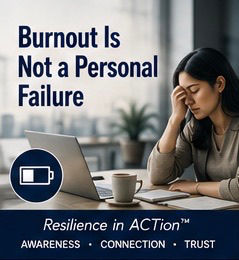
Burnout Is Not a Personal Failure

By Dr. Cyril Davis, DNP, PMHNP-BC
Few words are used more frequently in today's workplace than burnout.
Healthcare professionals talk about it. First responders experience it. Teachers, business leaders, caregivers, and working parents describe it. Yet despite how common burnout has become, many people continue to view it as a personal weakness rather than what it truly is: a human response to prolonged stress and overwhelming demands.
The truth is simple.
Burnout is not a character flaw.
It is not laziness.
It is not a lack of resilience.
And it is certainly not a sign that someone is incapable of doing their job.
Burnout is often the predictable outcome of carrying too much for too long without adequate support, recovery, or resources.
Understanding Burnout
Burnout develops gradually. It rarely appears overnight.
Many people begin with a deep sense of purpose and commitment. They care about their work, their patients, their communities, their families, and their organizations. Over time, however, constant demands can begin to outpace available energy.
The signs often include:
• Physical exhaustion
• Emotional fatigue
• Increased cynicism
• Reduced motivation
• Difficulty concentrating
• Sleep disturbances
• Feeling detached from work or relationships
• Loss of enjoyment in activities that once felt meaningful
Because burnout develops slowly, many individuals fail to recognize it until it begins affecting multiple areas of life.
The High Performer's Trap
One of the greatest misconceptions about burnout is that it only affects people who are struggling.
In reality, burnout often affects those who care the most.
High performers frequently place enormous expectations on themselves. They become the individuals others rely upon during difficult moments. They stay late. They take on additional responsibilities. They prioritize everyone else's needs before their own.
Over time, this pattern can become unsustainable.
I have seen this throughout my career in law enforcement, emergency medicine, and behavioral health.
Many of the strongest individuals I have encountered are also the ones most likely to delay asking for help. They tell themselves they can push through one more shift, one more project, one more challenge.
Eventually, however, even the strongest people reach a point where recovery becomes necessary.
My Personal Perspective
Years ago, a traumatic brain injury dramatically changed the direction of my life.
Recovery forced me to confront limitations I had never previously considered. It challenged my identity and my understanding of strength.
One of the most important lessons I learned was that resilience does not mean endlessly pushing forward without rest.
True resilience includes knowing when to slow down, seek support, and prioritize recovery.
Today, as a psychiatric mental health nurse practitioner, I often help individuals who have spent years caring for everyone but themselves.
Many are healthcare workers.
Many are first responders.
Many are leaders.
Many are caregivers.
Their stories differ, but the underlying message is often the same: they have been carrying too much for too long.
Burnout and Mental Health
Burnout and mental health are closely connected, though they are not identical.
Chronic stress can contribute to symptoms of anxiety, depression, irritability, emotional exhaustion, and physical health concerns.
When burnout goes unaddressed, people often begin questioning themselves.
They wonder why they feel exhausted despite working hard.
They blame themselves for struggling.
They assume they should be able to handle more.
Unfortunately, self-criticism rarely leads to healing.
Compassion does.
The Importance of Psychological Safety
Organizations also play an important role in preventing burnout.
When employees fear speaking up about workload concerns, mistakes, challenges, or personal struggles, burnout often worsens.
Psychological safety allows individuals to communicate openly without fear of judgment or retaliation.
It creates environments where people can ask for help, discuss concerns, and seek support before reaching a crisis point.
Healthy organizations understand that burnout is not simply an individual issue.
It is often a systems issue.
Practical Strategies for Recovery
While every situation is different, several strategies can help support recovery from burnout:
• Reconnect with your personal values.
• Establish healthier boundaries.
• Prioritize sleep and physical health.
• Take meaningful breaks.
• Seek professional support when needed.
• Strengthen supportive relationships.
• Reduce unnecessary commitments.
• Practice self-compassion.
Recovery is not about doing more.
Often, it begins by doing less and focusing on what truly matters.
Final Thoughts
One of the most damaging myths about burnout is the belief that strong people should be able to handle everything on their own.
The reality is that no one was designed to carry unlimited stress indefinitely.
Burnout is not evidence that you have failed.
It is information.
It is your mind and body communicating that something needs attention.
The goal is not to avoid stress entirely. Stress is part of life.
The goal is to develop sustainable ways to navigate challenges while maintaining your well-being.
If you are feeling exhausted, overwhelmed, or disconnected, know this:
You are not weak.
You are not broken.
And you are not alone.
Sometimes the strongest thing a person can do is acknowledge they need support and take the first step toward recovery.
Because resilience is not about carrying everything forever.
It is about knowing when to put some of the weight down.


Comments